Thursday, May 14, 2015

3 Nephi 1


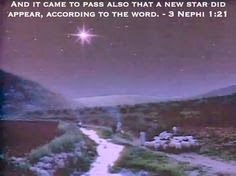
You know the Christmas story in the Bible – you know how the shepherds near Bethlehem and wise men from the East saw the star proclaiming the birth of the Christ child and went to see the little babe. But did you know that far across the ocean to the west, the people in the ancient Americas also saw the same star? And in 3 Nephi 1, we read the story! The Nephites actually had 2 signs from the heavens – 1 was the star which you already know about, and the other was a day and night and day with no darkness, as prophesied by Samuel the Lamanite.
Back in the book of Helaman, Samuel prophesied that the sign of Christ’s birth would occur in 5 years, and the people haven’t counted exactly which day Samuel made the prophecy, and now the non-believers have started to say that the time has passed.

5 But there were some who began to say that the time was past for the words to be fulfilled, which were spoken by Samuel, the Lamanite.
 6 And they began to rejoice over their brethren, saying: Behold the time is past, and the words of Samuel are not fulfilled; therefore, your joy and your faith concerning this thing hath been vain.
 7 And it came to pass that they did make a great uproar throughout the land; and the people who believed began to be very sorrowful, lest by any means those things which had been spoken might not come to pass.
 8 But behold, they did watch steadfastly for that day and that night and that day which should be as one day as if there were no night, that they might know that their faith had not been vain.

I feel like this is a classic predicament of believers in any point of history – holding on to faith with a firm resolve, even though most of the people around them don’t believe and are even mocking them. However, these believers' predicament becomes very serious:

 9 Now it came to pass that there was a day set apart by the unbelievers, that all those who believed in those traditions should be put to death except the sign should come to pass, which had been given by Samuel the prophet.

What?! How did the non-believers get the authority to do that?? I don’t know! Crazy things happened back in Bible times. And now the believers’ faith is really being put to the test.

The prophet, Nephi, is obviously very sad and concerned about the awful situation the believers are in. He goes to the Lord in prayer—intense prayer—and he receives this beautiful answer:

 13 Lift up your head and be of good cheer; for behold, the time is at hand, and on this night shall the sign be given, and on the morrow come I into the world, to show unto the world that I will fulfil all that which I have caused to be spoken by the mouth of my holy prophets.

This always makes me smile. Can you imagine? The Savior of all mankind—past, present, and future—the Son of God, the promised Messiah since the foundation of the world will be born TONIGHT. And God just told Nephi in answer to his prayer. God is acutely aware of his children.

15 And it came to pass that the words which came unto Nephi were fulfilled, according as they had been spoken; for behold, at the going down of the sun there was no darkness; and the people began to be astonished because there was no darkness when the night came.
 16 And there were many, who had not believed the words of the prophets, who fell to the earth and became as if they were dead, for they knew that the great plan of destruction which they had laid for those who believed in the words of the prophets had been frustrated; for the sign which had been given was already at hand.
 17 And they began to know that the Son of God must shortly appear; yea, in fine, all the people upon the face of the whole earth from the west to the east, both in the land north and in the land south, were so exceedingly astonished that they fell to the earth.
 18 For they knew that the prophets had testified of these things for many years, and that the sign which had been given was already at hand; and they began to fear because of their iniquity and their unbelief.
 19 And it came to pass that there was no darkness in all that night, but it was as light as though it was mid-day. And it came to pass that the sun did rise in the morning again, according to its proper order; and they knew that it was the day that the Lord should be born, because of the sign which had been given.
 20 And it had come to pass, yea, all things, every whit, according to the words of the prophets.
 21 And it came to pass also that a new star did appear, according to the word.

There’s the star! Isn’t this a remarkable story? I just love it, and I like to review it at Christmas time – it’s another faith-building perspective on the birth of Christ, and it demonstrates to me how God speaks to his people in all times and in all places, not just in the Bible lands and times.


Now on a less happy note, even though the people were so astonished at the sign that they fell to the ground in amazement and fear, miracles don’t create believers! Anyone can talk/rationalize/reason their way out of believing in a miracle. And unfortunately, so did many of the Nephites.

22 And it came to pass that from this time forth there began to be lyings sent forth among the people, by Satan, to harden their hearts, to the intent that they might not believe in those signs and wonders which they had seen

So the question for you today is—have you observed a miracle in your life (or multiple miracles!) that you have chosen to discount or rationalize away? And the next question is, why have you chosen to reason it away?

Thursday, May 7, 2015

Helaman 16


Samuel the Lamanite finishes his message from the top of the Nephite city wall. The reaction from the Nephites to his preaching is mixed. Some of the Nephites “believed on his word [and] went forth and sought for Nephi… desiring that they might be baptized unto the Lord. But as many as there were who did not believe in the words of Samuel were angry with him; and they cast stones at him upon the wall, and also many shot arrows at him as he stood upon the wall; but the Spirit of the Lord was with him, insomuch that they could not hit him with their stones neither with their arrows. Now when they saw that they could not hit him, there were many more who did believe on his words, insomuch that they went away unto Nephi to be baptized.” (vs. 1-3)


I’ve always thought Samuel was cool. There’s a song for primary children called “Book of Mormon Stories” and the verse about Samuel says:

Samuel the Lamanite, high on the city wall,
Came to warn the people, and repentance was his call.
Arrows could not hit him, for a man of God was he,
And he taught in the land righteously.

I also like this poster that was made for teenagers from the picture above, which is a well-known classic in the church. The words might be hard to read -- it says "Popularity: It's Overrated. Sometimes the crowd is just plain wrong."


The End of Samuel’s story, and the end of the book of Helaman! On to the book of 3rd Nephi!

Friday, April 10, 2015

Helaman 13-15


 Usually the Lord sends Nephite prophets to preach to the unbelieving Lamanites. But right now the Nephites are all very wicked, and the Lamanites are humble and faithful to God. A Lamanite prophet named Samuel is commanded by God to preach to the Nephites, and when the Nephites kick him out of the city, God tells him to go back and try again. So this time Samuel climbs up on the city wall and preaches from the top! I think Samuel is pretty cool. He has some important messages to deliver from the Lord, including:
  • The Lord is going to curse the land because the people are full of pride and their hearts are set on riches. They will hide their riches, and never be able to find them again (vs. 22-23, 31-36).
  • They have “have sought for happiness in doing iniquity” (vs. 38) which never ever works out in the end.
  • They have rejected the words of the prophets, and without even realizing it.
It’s very easy for us to look at people in Biblical times and say “wow, how could the people have been so bad and stubborn?” or “how could the people have ignored a man sent from God?” But here's the hard question -- what about you, today? Are you letting God’s servants and spokesmen get through to you? Or is that just a thing of the past? Can you see any modern application for Samuel's words to the Nephites?:

 25 And now when ye talk, ye say: If our days had been in the days of our fathers of old, we would not have slain the prophets; we would not have stoned them, and cast them out.

 26 Behold ye are worse than they; for as the Lord liveth, if a prophet come among you and declareth unto you the word of the Lord, which testifieth of your sins and iniquities, ye are angry with him, and cast him out and seek all manner of ways to destroy him; yea, you will say that he is a false prophet, and that he is a sinner, and of the devil, because he testifieth that your deeds are evil.

27 But behold, if a man shall come among you and shall say: Do this, and there is no iniquity; do that and ye shall not suffer; yea, he will say: Walk after the pride of your own hearts; yea, walk after the pride of your eyes, and do whatsoever your heart desireth—and if a man shall come among you and say this, ye will receive him, and say that he is a prophet.

The most important message that Samuel the Lamanite has to deliver to the Nephites is that the Son of God, the Savior of the World, the Messiah whose coming has been prophesied by all prophets since the beginning of the world, would be born in five years. Five years! In the span of earth’s history, that’s the blink of an eye! This is huge news. The Messiah will be born across the ocean, far away from the ancient Americas where the Nephites and Lamanites are, but Samuel tells them of signs that will occur when the Holy Baby is born:
  1. “There shall be great lights in heaven, insomuch that in the night before he cometh there shall be no darkness, insomuch that it shall appear unto man as if it was day. Therefore, there shall be one day and a night and a day, as if it were one day and there were no night…for ye shall know of the rising of the sun and also of its setting; therefore they shall know of a surety that there shall be two days and a night; nevertheless the night shall not be darkened; and it shall be the night before he is born.” (vs 3-4)
  2. “There shall a new star arise, such an one as ye never have beheld” (vs. 5) Does this sound familiar? Cool huh? The star that was seen by the shepherds was also seen by wise men in the far East, AND was also seen by Nephites/Lamanites in the far, far West!
  3. “And behold this is not all, there shall be many signs and wonders in heaven.” (vs. 6)
Big news, right? But this isn’t all. Samuel also prophecies of the signs that will occur in the Americas when the Son of God is killed. These include:
  1. “In that day that he shall suffer death the sun shall be darkened and refuse to give his light unto you; and also the moon and the stars; and there shall be no light upon the face of this land, even from the time that he shall suffer death, for the space of three days, to the time that he shall rise again from the dead.” (vs. 20)
  2. “At the time that he shall yield up the ghost there shall be thunderings and lightnings for the space of many hours, and the earth shall shake and tremble; and the rocks which are upon the face of this earth…shall be broken up” (vs. 21)
You will find that all these prophecies come to pass, just as Samuel said (so keep reading!). While it is cool and interesting and important for the Nephites to know about these earthquakes, and a night without darkness, and new star, etc., the primary purpose for Samuel (or any prophet) sharing these prophecies is to increase our faith, and encourage us to repent so that we will be ready to meet Christ. If you truly believe something, it will change you.
12 For this intent have I come up upon the walls of this city…that ye might know of the coming of Jesus Christ, the Son of God, the Father of heaven and of earth, the Creator of all things from the beginning; and that ye might know of the signs of his coming, to the intent that ye might believe on his name.
 13 And if ye believe on his name ye will repent of all your sins, that thereby ye may have a remission of them through his merits.

Nobody likes it when their rivals are held up as an example for them to follow, but in this case the Nephites needed/deserved it. Samuel the Lamanites is still preaching to the Nephites from on top of the city wall, and he talks about how good and righteous the Lamanites have become, and how wicked, prideful, and rebellious the Nephites have become despite all the miracles and blessings the Lord has sent to them.

Samuel prophesies that the Nephites will be completely destroyed if they don’t repent (see vs. 17; and spoiler alert—it happens as Samuel says), and the Lord will show mercy to the Lamanites because of this great period of goodness from the Lamanites. Samuel also prophesies that if the Lamanites ever “fall away” from the Lord again, the Lord promises to bring them back someday.
12 Yea, I say unto you, that in the latter times the promises of the Lord have been extended to our brethren, the Lamanites; and notwithstanding the many afflictions which they shall have, and notwithstanding they shall be driven to and fro upon the face of the earth, and be hunted, and shall be smitten and scattered abroad, having no place for refuge, the Lord shall be merciful unto them.
 13 And this is according to the prophecy, that they shall again be brought to the true knowledge, which is the knowledge of their Redeemer, and their great and true shepherd, and be numbered among his sheep.
Guess what -- this happened, too. The Lamanites are the ancestors of the Native Americans and the people of Central and South America. We all know how these people were “driven to and fro upon the face of the earth, and hunted, and smitten and scattered abroad” by the Europeans who came to settle this continent. And now, today the fastest growing area of the Church of Jesus Christ of Latter-day Saints is in Central and South America, among these descendants of the Lamanites who are being “brought again to the true  knowledge of their Redeemer” as the prophecy stated. Pretty cool, huh?

Saturday, March 7, 2015

Helaman 10-12

Helaman 10
Have you ever become burned out in your efforts to help someone or do good in some way? Have you ever worked your guts out to make a difference for someone or something—even just to change yourself—and been utterly discouraged at the lack of results or the endlessness of the effort required? I have been (being in the middle of launching/growing a new business, I’ll admit I am currently feeling that way). During multiple such occasions in my life, Nephi has been a hero I have looked to with admiration and respect. 

He has spent years preaching to the Nephites, only to watch them drift further and further from faith in God. He has just had a particularly baffling experience where he prophesied a remarkable event that was fulfilled in front of hundreds if not thousands of people. And still the people just departed from him, returning to their old lives and their old ways. He seems to be devoting every hour of his life to bringing people to God, and yet the people only get worse. Talk about discouraging. 

I feel a little hope in the fact that Nephi—a great and faithful prophet—felt discouraged. It says he was walking home and “much cast down because of the wickedness of the people (v. 3)” when a voice spoke to him saying:
 4 Blessed art thou, Nephi, for those things which thou hast done; for I have beheld how thou hast with unwearyingness declared the word, which I have given unto thee, unto this people. And thou hast not feared them, and hast not sought thine own life, but hast sought my will, and to keep my commandments.
 5 And now, because thou hast done this with such unwearyingness, behold, I will bless thee forever; and I will make thee mighty in word and in deed, in faith and in works; yea, even that all things shall be done unto thee according to thy word, for thou shalt not ask that which is contrary to my will.
Unwearyingness—what a cool word! Nephi spent all of his time doing what God wanted him to do, and he never gave up, even when he wasn’t seeing results. He cared much more what God thought about him than what other people thought about him. I wish I could be more like that.

And because Nephi had turned his life over to God, he was basically granted ultimate power from God. Whatever he says will happen. God gives him this power because he can trust him. This is a very meaningful lesson to me; I can’t always control what other people do, and whether or not others will change or do what is best for them, but I can control myself and find happiness and blessings, including power & strength from God, as a reward. 

Nephi in his remarkable faith and obedience turns on his heels immediately after talking with God and returns to preaching, despite the incredibly discouraging experience he had just had with preaching to the Nephites. I am in awe of Nephi.
 12 And behold, now it came to pass that when the Lord had spoken these words unto Nephi, he did stop and did not go unto his own house, but did return unto the multitudes who were scattered about upon the face of the land, and began to declare unto them the word of the Lord which had been spoken unto him, concerning their destruction if they did not repent.


The people have rejected Nephi’s preaching and a great war breaks out among them. Nephi exercises his new powers from the Lord, and requests the Lord to smite the earth with famine instead of with war. The Lord grants the request, and before long the people stop their fighting because the famine has become so severe that people are dying in large numbers all across the land. The famine serves its purpose, and causes the people to be humble and finally start thinking about repenting. The people repent and beg Nephi to ask God to take away the famine. The famine is removed, and the people begin to prosper again.

But the peace doesn’t last long, as a group dissents into the “mountains and the wilderness” and begins to build up a secret band of Gadianton Robbers again. No!! The Gadianton Robbers are always big trouble in the Book of Mormon. More and more people dissent and join the secret group, and even though the Nephites and Lamanites both send armies into the mountains to try to destroy the robbers, they are unsuccessful, and the robber group grows steadily while the Nephites and Lamanites fall back into wickedness and pride themselves.


Mormon, who has been summarizing these swings between wickedness and righteousness, laments over the unstable nature of men. It seems that in some cases it is man’s own fault for the misfortune that comes upon him, because his pride and forgetfulness has caused God to shake him to remembrance.
And thus we can behold how false, and also the unsteadiness of the hearts of the children of men; yea, we can see that the Lord in his great infinite goodness doth bless and prosper those who put their trust in him.
4 O how foolish, and how vain, and how evil, and devilish, and how quick to do iniquity, and how slow to do good, are the children of men; yea, how quick to hearken unto the words of the evil one, and to set their hearts upon the vain things of the world!
5 Yea, how quick to be lifted up in pride; yea, how quick to boast, and do all manner of that which is iniquity; and how slow are they to remember the Lord their God, and to give ear unto his counsels, yea, how slow to walk in wisdom’s paths!
 6 Behold, they do not desire that the Lord their God, who hath created them, should rule and reign over them; notwithstanding his great goodness and his mercy towards them, they do set at naught his counsels, and they will not that he should be their guide.

Saturday, February 21, 2015

Helaman 6-9

Helaman 6
There are a couple times in the Book of Mormon where the Lamanites become more righteous than the Nephites. This is one of them. The Nephites and Lamanites are at peace with each other, and they do business & trade together and travel freely among each other. That hasn’t really happened before! But the wealth and prosperity that comes from these collaborative years begins to foster pride amongst the Nephites, and pride is always the poison that ruins peace and leads to destruction. A band of the secret “Gadianton Robbers” re-emerges, who pledge to defend and support each other in their covert attempts to gain power. This secret society grows until it becomes very strong among the Nephites, but the Lamanites seek it out and preach the word of God and squash the growth of the secret band before it takes over. So at the end of the chapter, the Lamanites are in a much better position than the Nephites, who are starting to destruct from within.


Nephi, the great missionary, has returned from his missionary efforts to his homeland of Zarahemla and is weighed down by the wickedness and corruption that is taking over the Nephites. One day Nephi is sitting on a tower in his garden, which is apparently right by a major “highway” of the Nephites, and starts praying his heart out to God, feeling totally discouraged by the wickedness among his people. Many people traveling on the highway hear him and stop to listen. Nephi eventually discovers he has an audience, and turns around to preach to the people who have gathered. Honestly, I’ve always thought that was a little weird, because why was Nephi praying so loudly and openly when he knew his back garden was right along a public thorough-fare, but I guess sometimes people (even prophets) do funny things.


Nephi has been preaching to the crowd of by-standers outside his garden, telling them about their wickedness and prophesying of their destruction if they don’t repent. Some people in the crowd (the guilty ones, of course) are angry with Nephi and try to stir the crowd up against him. Others in the crowd believe Nephi and tell the others to listen to him and leave him alone. He has enough support in the crowd that the angry/scheming people don’t dare to touch Nephi, and he is able to continue preaching.  His primary message is the message all prophets are sent to testify of—that the Son of God will come into the world.
And while Nephi has the “spirit of prophesy” upon him, he receives and shares a revelation of political significance:
26 Yea, even at this time ye are ripening, because of your murders and your fornication and wickedness, for everlasting destruction; yea, and except ye repent it will come unto you soon.
 27 Yea, behold it is now even at your doors; yea, go ye in unto the judgment-seat, and search; and behold, your judge is murdered, and he lieth in his blood; and he hath been murdered by his brother, who seeketh to sit in the judgment-seat.
 28 And behold, they both belong to your secret band, whose author is Gadianton and the evil one who seeketh to destroy the souls of men.

Five men in the crowd listening to Nephi run to the judgment seat to see if Nephi’s prophecy is true—to see if the chief judge has really been murdered. They are shocked to discover the chief judge lying dead, and fall to the earth with fear and amazement because they now believe Nephi and everything he has been preaching. Unfortunately for these men, it looks bad when all the servants of the king come in to find him lying dead surrounded by these 5 men, and of course they are accused of being the murderers and thrown in prison.

The next day at the funeral, the crowd from Nephi's house starts asking what happened to the 5 men who went to see if Nephi’s prophecy was true. At that point they learn that 5 men were captured at the scene of the crime, and they are able to testify that the 5 men are innocent and release them from prison. But then the people turn on Nephi, accusing him that he plotted with someone to kill the chief judge so he could “prophesy” about it and look like a great prophet.

Nephi squashes that accusation with another prophesy. He tells the men to go to the house of the chief judge’s brother, and accuse him of the murder. Nephi predicts he will deny the crime, but then if the men examine his clothing they will find blood on his robes, and if they continue to accuse the brother he will start shaking and confess. The men go, and the events occur just as Nephi prophesies, and the brother also says that Nephi was not involved in any way.

I found a video of this story! Warning: it's definitely old school--probably 20 to 30 years old--so set your expectations accordingly. :)